Right Triangle Trigonometry
Trigonometry studies the relationships between sides and angles of triangles. Right triangle trigonometry focuses on triangles with a 90° angle, using the ratios Sine, Cosine, and Tangent to find unknown sides and angles.
This guide covers SOH-CAH-TOA, finding missing sides and angles, inverse trig functions, real-world applications, worked examples with full steps, and an interactive triangle explorer.
1Introduction
At its heart, trigonometry is the study of relationships between the sides and angles of triangles. A right triangle contains one angle measuring exactly 90 degrees. The magic of trigonometry lets us find unknown side lengths or angle measures even when we only have partial information.
The core of right triangle trigonometry can be remembered with a simple mnemonic: SOH-CAH-TOA. This handy phrase helps us recall the three primary trigonometric ratios: Sine, Cosine, and Tangent.
Imagine you’re standing on the ground, looking up at the top of a tall tree. You know how far you are from the base, and you can measure the angle to the treetop. With trigonometry, you can calculate the exact height of that tree without ever climbing it! That’s the power of SOH-CAH-TOA.
Trigonometry is used by architects to design buildings, engineers to build bridges, navigators to chart courses, astronomers to measure distances to stars, and even in video game development for realistic movement.
2Key Definitions
Right Triangle
A triangle with one angle measuring 90 degrees.
Hypotenuse
The longest side, always directly opposite the 90° angle.
Opposite Side
The side directly across from the reference angle (not the right angle).
Adjacent Side
The side next to the reference angle that is not the hypotenuse.
Sine (sin)
Opposite / Hypotenuse. Relates the opposite side to the hypotenuse.
Cosine (cos)
Adjacent / Hypotenuse. Relates the adjacent side to the hypotenuse.
Tangent (tan)
Opposite / Adjacent. Relates the opposite side to the adjacent side.
Inverse Trig Functions
sin¹, cos¹, tan¹ — used to find the angle when you know the ratio of two sides.
Angle of Elevation
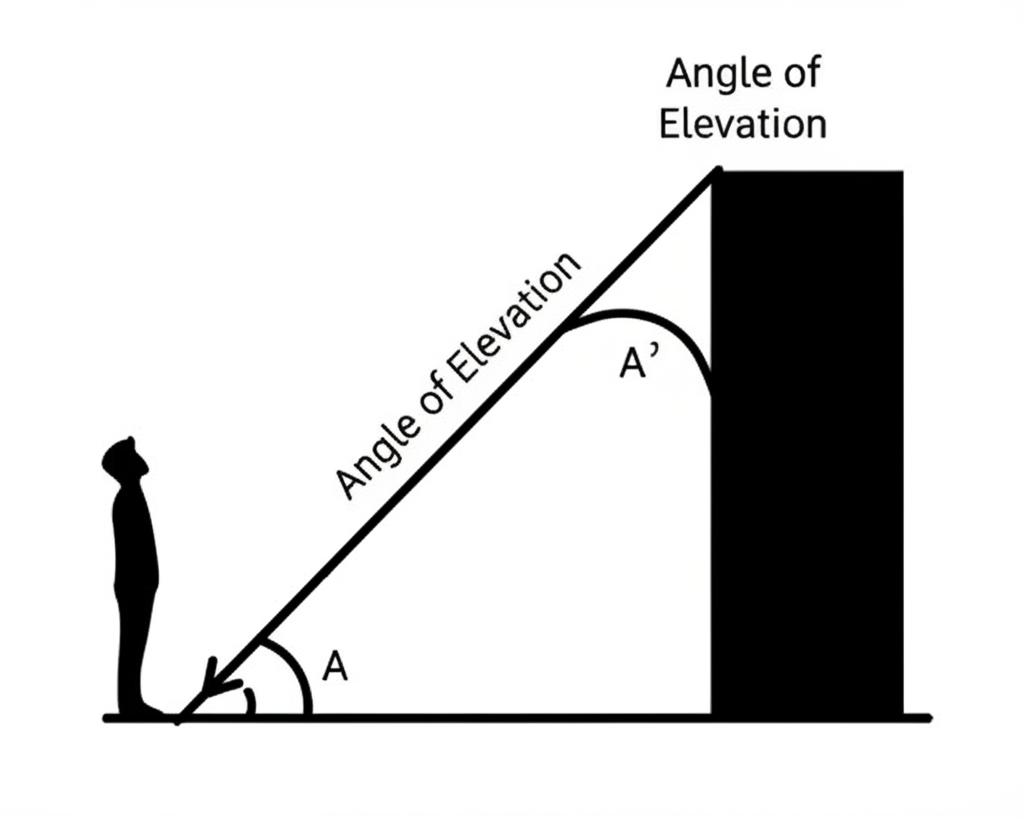
Angle measured upward from a horizontal line to the line of sight.
Angle of Depression
Angle measured downward from a horizontal line to the line of sight.
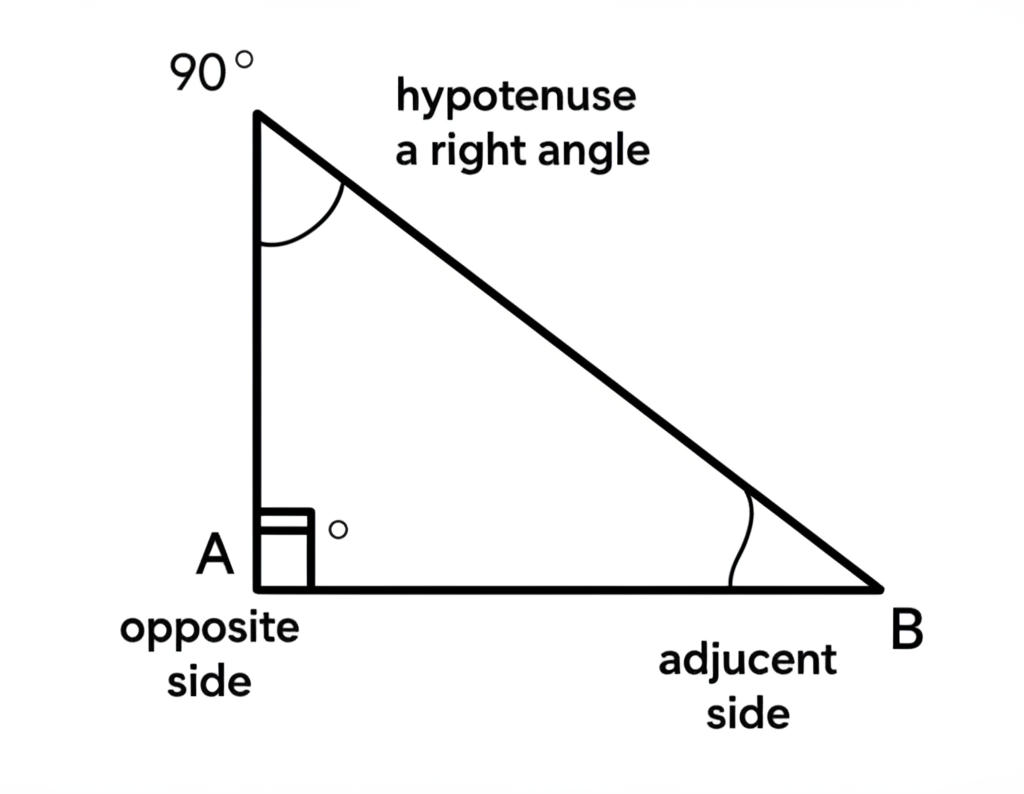
The hypotenuse is always the same, but the opposite and adjacent sides change depending on which angle you choose as your reference angle. Always label from the perspective of the specific angle you’re working with.
3SOH-CAH-TOA Explained
This mnemonic is your best friend in right triangle trigonometry. Each part tells you which ratio to use:
SOH
Sine
Opposite
Hypotenuse
sin(θ) = Opp / Hyp
CAH
Cosine
Adjacent
Hypotenuse
cos(θ) = Adj / Hyp
TOA
Tangent
Opposite
Adjacent
tan(θ) = Opp / Adj
SOH: Sine = Opposite / Hypotenuse
Use Sine when you know (or want to find) the opposite side and the hypotenuse.
Example: angle = 30°, hypotenuse = 10. Find opposite.
sin(30°) = Opposite / 10
Opposite = 10 × sin(30°)
Opposite = 10 × 0.5
Opposite = 5
CAH: Cosine = Adjacent / Hypotenuse
Use Cosine when you know (or want to find) the adjacent side and the hypotenuse.
Example: angle = 60°, adjacent = 7. Find hypotenuse.
cos(60°) = 7 / Hypotenuse
Hypotenuse = 7 / cos(60°)
Hypotenuse = 7 / 0.5
Hypotenuse = 14
TOA: Tangent = Opposite / Adjacent
Use Tangent when you know (or want to find) the opposite side and the adjacent side.
Example: angle = 45°, opposite = 8. Find adjacent.
tan(45°) = 8 / Adjacent
Adjacent = 8 / tan(45°)
Adjacent = 8 / 1
Adjacent = 8
Common Trig Values
| Angle | sin(θ) | cos(θ) | tan(θ) |
|---|---|---|---|
| 0° | 0 | 1 | 0 |
| 30° | 0.5 | √3/2 | √3/3 |
| 45° | √2/2 | √2/2 | 1 |
| 60° | √3/2 | 0.5 | √3 |
| 90° | 1 | 0 | undef |
Right Triangle Explorer
InteractiveAdjust the angle and hypotenuse to see how the trig ratios change in real-time. Watch the triangle reshape as you move the sliders.
SOH — Sine
sin(35°) = 0.5736
Opp / Hyp = 5.74 / 10.0
CAH — Cosine
cos(35°) = 0.8192
Adj / Hyp = 8.19 / 10.0
TOA — Tangent
tan(35°) = 0.7002
Opp / Adj = 5.74 / 8.19
Opposite
5.74
Adjacent
8.19
Hypotenuse
10.0
4Finding Missing Sides
When you know one acute angle and one side length, you can use SOH-CAH-TOA to find any missing side.
Identify the reference angle
This is the non-90° angle you are given or working with.
Label the sides
Identify the opposite, adjacent, and hypotenuse from the reference angle’s perspective.
Choose the correct ratio
Opp & Hyp → Sine • Adj & Hyp → Cosine • Opp & Adj → Tangent
Set up & solve
Write the equation, substitute knowns, and solve algebraically. Make sure your calculator is in DEGREE mode!
Example: angle = 35°, adjacent = 12 cm. Find hypotenuse.
cos(35°) = Adjacent / Hypotenuse = 12 / x
x × cos(35°) = 12
x = 12 / cos(35°)
x ≈ 12 / 0.819
x ≈ 14.65 cm
5Finding Missing Angles (Inverse Trig)
When you know two side lengths, you can find a missing acute angle using inverse trig functions (arcsin, arccos, arctan).
sin¹
Use when you know Opposite & Hypotenuse
cos¹
Use when you know Adjacent & Hypotenuse
tan¹
Use when you know Opposite & Adjacent
Example: opposite = 8, adjacent = 6. Find angle A.
tan(A) = Opposite / Adjacent = 8 / 6
A = arctan(8/6)
A = arctan(1.333...)
A ≈ 53.13°
To use inverse trig on most calculators, press SHIFT or 2ND, then sin, cos, or tan. Always verify your calculator is in DEGREE mode — look for “DEG” on the display.
6Real-World Applications
Trigonometry solves real-world problems involving distances and heights that are difficult to measure directly.
Height of a Building or Tree
Know your distance from the base + angle of elevation → use tangent to find height.
Standing 100 ft from a flagpole, angle of elevation = 40°. Height = 100 × tan(40°) ≈ 83.9 ft
Distance Across a River
Walk along one bank, measure an angle to the opposite shore → use tangent to find width.
Walk 50 m along bank, angle to opposite point = 65°. Width = 50 × tan(65°) ≈ 107.2 m
Length of a Ladder or Ramp
Know the height + angle of incline → use sine or cosine to find length.
Ladder at 70°, base 6 ft from wall. Length = 6 / cos(70°) ≈ 17.5 ft
Navigation & Aviation
Pilots use angle of depression to calculate ground distance. Surveyors use angles for mapping.
Plane at 10,000 ft, depression angle = 15°. Ground distance = 10,000 / tan(15°) ≈ 37,321 ft
Special Right Triangles
45-45-90 Triangle
Legs are equal
If leg = a, then:
Hypotenuse = a√2
30-60-90 Triangle
Short leg (opposite 30°) = a
Long leg (opposite 60°) = a√3
Hypotenuse = 2a
7Worked Examples
Problem: In a right triangle with angle A = 30° and hypotenuse = 10, find the opposite side.
Step 1: Identify — we have angle + hypotenuse, want opposite → use SOH
Step 2: sin(A) = opposite / hypotenuse
Step 3: sin(30°) = x / 10
Step 4: 0.5 = x / 10
Step 5: x = 10 × 0.5
Answer: The opposite side is 5
Method: SOH (Sine = Opposite / Hypotenuse)
Problem: In a right triangle, opposite = 4, adjacent = 3. Find angle A.
Step 1: Identify — we have opposite + adjacent, want angle → use TOA + inverse
Step 2: tan(A) = opposite / adjacent
Step 3: tan(A) = 4 / 3
Step 4: A = arctan(4/3)
Step 5: A = arctan(1.333...)
Answer: Angle A ≈ 53.1°
Method: Inverse tangent (tan¹)
Problem: If angle B = 60° and adjacent side = 8, find the hypotenuse.
Step 1: Identify — we have angle + adjacent, want hypotenuse → use CAH
Step 2: cos(B) = adjacent / hypotenuse
Step 3: cos(60°) = 8 / x
Step 4: 0.5 = 8 / x
Step 5: 0.5x = 8
Step 6: x = 8 / 0.5
Answer: The hypotenuse is 16
Method: CAH (Cosine = Adjacent / Hypotenuse)
Problem: A ladder leans against a wall making 70° with the ground. The foot of the ladder is 6 feet from the wall. How long is the ladder?
Step 1: Draw diagram — ladder = hypotenuse, ground = adjacent, wall = opposite
Step 2: Reference angle = 70°, Adjacent = 6 ft, Hypotenuse = x
Step 3: cos(70°) = adjacent / hypotenuse = 6 / x
Step 4: cos(70°) ≈ 0.342
Step 5: 0.342 = 6 / x
Step 6: 0.342x = 6
Step 7: x = 6 / 0.342
Answer: The ladder is approximately 17.54 feet long
Method: Angle of elevation with cosine
Problem: From a point 50 meters from the base of a tree, the angle of elevation to the top is 25°. How tall is the tree?
Step 1: Draw diagram — tree = opposite, distance = adjacent, line of sight = hypotenuse
Step 2: Reference angle = 25°, Adjacent = 50 m, Opposite = h
Step 3: tan(25°) = opposite / adjacent = h / 50
Step 4: tan(25°) ≈ 0.466
Step 5: 0.466 = h / 50
Step 6: h = 50 × 0.466
Answer: The tree is approximately 23.3 meters tall
Method: Angle of elevation with tangent
8Memory Aids
SOH-CAH-TOA — the first letter of each word matches the mnemonic. S-O-H = Sine, Opposite, Hypotenuse. C-A-H = Cosine, Adjacent, Hypotenuse. T-O-A = Tangent, Opposite, Adjacent.
The hypotenuse is always the longest, most “hyped” side and sits opposite the right angle. It’s always across from the 90° corner.
The opposite side is across from your angle (like sitting opposite someone at a table). The adjacent side is right beside it (like sitting adjacent to someone).
Regular trig (sin, cos, tan) goes from angle → ratio. Inverse trig (sin¹, cos¹, tan¹) goes from ratio → angle. It “undoes” the trig function.
Angle of elevation: your eyes look up from horizontal. Angle of depression: your eyes look down from horizontal. Both start from a flat line.
9Common Mistakes to Avoid
Calculator in Radian Mode
Wrong: sin(30) = −0.988 (calculator in radian mode)
Right: sin(30°) = 0.5. Always check for “DEG” on your calculator display before starting.
Mixing Up Opposite and Adjacent Sides
Wrong: Labeling sides without considering which angle you’re working from
Right: Always label from the perspective of your specific reference angle. Opposite and adjacent swap if you change angles.
Choosing the Wrong Trig Ratio
Wrong: Using sin when you have adjacent and hypotenuse (should be cos)
Right: Identify which two sides are involved, then pick: SOH, CAH, or TOA. Write out which sides you have before choosing.
Using the Right Angle as Reference
Wrong: Trying to use SOH-CAH-TOA with the 90° angle
Right: SOH-CAH-TOA only works with the acute angles of a right triangle. Never use the 90° angle as your reference.
Algebraic Errors When Solving
Wrong: cos(35°) = 12/x → x = 12 × cos(35°) (multiplied instead of divided)
Right: cos(35°) = 12/x → x × cos(35°) = 12 → x = 12 / cos(35°). Cross-multiply carefully.
Forgetting to Use Inverse Functions
Wrong: Typing sin(4/3) to find an angle when you know opposite = 4, adjacent = 3
Right: You need arctan(4/3) or tan¹(4/3). Regular trig gives you a ratio; inverse trig gives you an angle.
Rounding Too Early
Wrong: cos(35°) = 0.82, then 12/0.82 = 14.63 (rounded intermediate value)
Right: Keep full precision during calculation: cos(35°) = 0.81915…, then 12/0.81915 = 14.647. Round only the final answer.
10Quick Revision Summary
- Right triangles have one 90° angle. The hypotenuse is always opposite it.
- SOH: sin(θ) = Opposite / Hypotenuse.
- CAH: cos(θ) = Adjacent / Hypotenuse.
- TOA: tan(θ) = Opposite / Adjacent.
- To find a missing side, use sin, cos, or tan with the known angle and side.
- To find a missing angle, use sin¹, cos¹, or tan¹ with two known sides.
- Always verify your calculator is in DEGREE mode.
- Angle of elevation looks up; angle of depression looks down. Both from horizontal.
- 45-45-90: legs are equal, hypotenuse = leg × √2.
- 30-60-90: hypotenuse = 2 × short leg, long leg = short leg × √3.
- SOH-CAH-TOA only works with right triangles.
- Draw diagrams and label sides before solving — it prevents most errors.
Frequently Asked Questions
What is the easiest way to remember SOH-CAH-TOA?
SOH-CAH-TOA is a mnemonic: Sine = Opposite/Hypotenuse (SOH), Cosine = Adjacent/Hypotenuse (CAH), Tangent = Opposite/Adjacent (TOA). Some students use the phrase "Some Old Hippie Caught Another Hippie Trippin' On Acid" to remember the letters.
How do I know which trig ratio to use?
Label the sides relative to your reference angle as Opposite, Adjacent, and Hypotenuse. Then look at which two sides are involved (one known, one unknown). If it's Opposite and Hypotenuse, use Sine. Adjacent and Hypotenuse, use Cosine. Opposite and Adjacent, use Tangent.
Why does my calculator give the wrong answer for trig problems?
The most common reason is that your calculator is in RADIAN mode instead of DEGREE mode. Always check this first. On most calculators, look for "DEG" on the display. If you see "RAD," switch to degree mode.
What is the difference between angle of elevation and angle of depression?
Both are measured from a horizontal line. The angle of elevation looks UP from the horizontal to an object above you (like the top of a building). The angle of depression looks DOWN from the horizontal to an object below you (like a boat from a cliff). They are alternate interior angles and are equal.
Can I use SOH-CAH-TOA with any triangle?
No — SOH-CAH-TOA only works with right triangles (triangles that have a 90° angle). For non-right triangles, you need the Law of Sines or the Law of Cosines.
Practice Quiz
Test your understanding — select the correct answer for each question.
1.In SOH-CAH-TOA, what does SOH stand for?
2.If sin(A) = 3/5, what is cos(A)?
3.What is tan(45°)?
4.In a 30-60-90 triangle, the shorter leg is 5. What is the hypotenuse?
5.The angle of elevation is measured from:
6.If cos(A) = 1/2, what is angle A?
7.What is the hypotenuse in a right triangle?
8.tan(A) = opposite / ?
9.A right triangle has legs 9 and 12. What is the hypotenuse?
10.If sin(A) = 0.5, what could angle A be?
Study Tips
- Memorize SOH-CAH-TOA first — everything builds on knowing which ratio to use. Use the mnemonic until it’s automatic.
- Always draw and label — sketch the triangle, mark the right angle, label sides from your reference angle’s perspective.
- Use the interactive explorer above — adjust the angle and hypotenuse to build intuition for how trig ratios change.
- Practice both directions — solve problems finding missing sides AND missing angles. Inverse trig often trips students up.
- Check your calculator mode — before every problem, verify you’re in DEGREE mode. This prevents the most common error.