Falling Behind in First Year of University? How to Catch Up
Tutoremy Team
Editorial · November 13, 2026
If you're reading this with a stack of unwatched lectures, three deadlines next week and a growing feeling that everyone else has it figured out, start here: falling behind in first year is extremely common, and it is almost always recoverable.
First year is a big jump. There's less structure than school, more independent reading, assessments spread across several modules with different rules, and usually a whole new life to set up at the same time. Nobody is born knowing how to run all of that. It's a skill, and you can learn it now.
This guide is practical. It covers how to stop the backlog from growing, how to triage what's already piled up, a weekly system that's simple enough to stick to, and when to ask for help (earlier than you think).
First: stop the pile from growing
Before you touch the backlog, protect this week. Catching up on week 3 while missing week 7 just moves the problem.
For the next seven days:
- Go to (or watch) every new lecture and seminar this week. Live if you can. New material is easier to keep up with than to catch up on.
- Write down every deadline in one place. Every module, every assignment, every quiz, every lab report, with dates and how much each is worth. Your course handbook, the learning platform and module pages usually list them.
- Sleep and eat at roughly regular times. It sounds unrelated. It isn't; tired brains make poor plans and procrastinate more.
That's it for the first step. You've drawn a line: from here on, the backlog stops growing.
Triage the backlog
Now look at everything you're behind on and sort it. The goal isn't to do it all; it's to do the parts that matter most first.
1. List everything. Unwatched lectures, unread readings, unfinished problem sets, assignments not started. Put it all on one page so it stops floating around in your head.
2. Mark each item by two things:
| Counts toward your grade soon | Doesn't count soon | |
|---|---|---|
| Needed to understand what comes next | Do first | Do second |
| Not needed for what comes next | Do third | Do last, or skim |
- Do first: an assignment due in two weeks that relies on lectures you missed. Watch those lectures with the assignment in front of you.
- Do second: foundational lectures in a module where later topics build on earlier ones (common in maths, sciences, economics, programming).
- Do third: graded work that stands on its own.
- Do last: optional readings and topics that won't come up again until revision.
3. Check what each assessment is worth. In many first-year programmes, some early assessments count little or nothing toward your final degree result. Check your own course rules; don't assume. Knowing which deadlines carry real weight helps you decide where your hours go.
4. Catch up on lectures efficiently. You don't need to rewatch everything at normal speed. Skim the slides first to see what the lecture covers, watch at a speed you can still follow, pause to write the key ideas in your own words, and spend more time on the bits that the assignments and past exam questions rely on. If you study from recordings a lot, how to study from a lecture recording goes into detail.
A weekly system that actually holds
Complicated planners collapse the first busy week. This one takes about 20 minutes on a Sunday and a few minutes each day.
Sunday (20 minutes): plan the week.
- Look at the deadline list for the next two weeks.
- Block your fixed commitments: lectures, seminars, labs, work shifts, travel.
- Give each module two or three study blocks of 60 to 90 minutes. Put the hardest module in your best hours.
- Add one catch-up block for the backlog, and one buffer block that stays empty for whatever goes wrong.
After each lecture (10 minutes): close the loop. Write three to five lines: what was it about, what's one thing you didn't follow, and what do you need to do before the next one. This tiny habit stops lectures from blurring together. For more on capturing lectures well, see how to take better notes in college.
Each study block: start with a quick self-test. Spend the first five minutes trying to recall last week's material for that module without looking. Then do the new work. This builds in spaced review for free, which is one of the most reliable ways to remember what you study (spaced repetition explained).
Friday (5 minutes): check the list. What got done? What moved? Adjust next week's plan. If one module keeps getting skipped, that's a signal, not a character flaw: maybe it needs a smaller first step or a different time slot.
When starting is the hard part
If you sit down to study and end up on your phone for an hour, you're not lazy. Avoidance usually grows when a task feels too big or too unclear, and being behind makes everything feel big. A few things help:
- Shrink the first step. Not "catch up on economics." Instead, "open lecture 4 slides and read the first three."
- Use a timer. 25 minutes on, 5 off. Starting is easier when you know it will end.
- Work somewhere else. A library or a study space with other people working helps a lot of students.
- Put the phone in another room. Not face down. Another room.
If this is a pattern for you, why you procrastinate studying looks at the causes and fixes in more depth. If you think focus difficulties go beyond the usual, how to study with ADHD may help, and it's worth talking to your university's disability or wellbeing service.
When (and how) to ask for help
The single most common first-year mistake isn't falling behind. It's waiting too long to tell anyone. Staff can do far more for you three weeks before a deadline than three hours before it.
Ask your lecturer or tutor when: you don't understand a core topic after trying, you've missed a significant part of a module, or you're unsure what an assignment is asking. Go to office hours with something specific: "I've watched lectures 3 and 4 but I don't follow how X leads to Y."
Ask your personal tutor, academic adviser or programme office when: you're behind in more than one module, you might miss a deadline, or you're wondering whether your course is right for you. They know the options, which might include extensions, extenuating or mitigating circumstances processes, deferrals or changing your study load. The names and rules vary between universities, so ask about yours.
Use student support services when: stress, low mood, anxiety, money, housing or a health issue is part of why you're behind. Most universities offer free counselling, wellbeing and disability support. Using them is normal and confidential.
If you're struggling to cope or feel unsafe, contact your university's support service, a doctor, or a local crisis line straight away. Your studies can wait; you come first.
What "caught up" actually looks like
You don't need to have watched every lecture twice and done every optional reading. You're caught up when:
- You know every deadline and have a plan for each.
- You can follow the current lectures in each module.
- You've done the foundational topics later material depends on.
- You have a weekly routine that includes some review.
That's a realistic target for two to four weeks of steady work, not one heroic weekend.
How Tutoremy can help you catch up
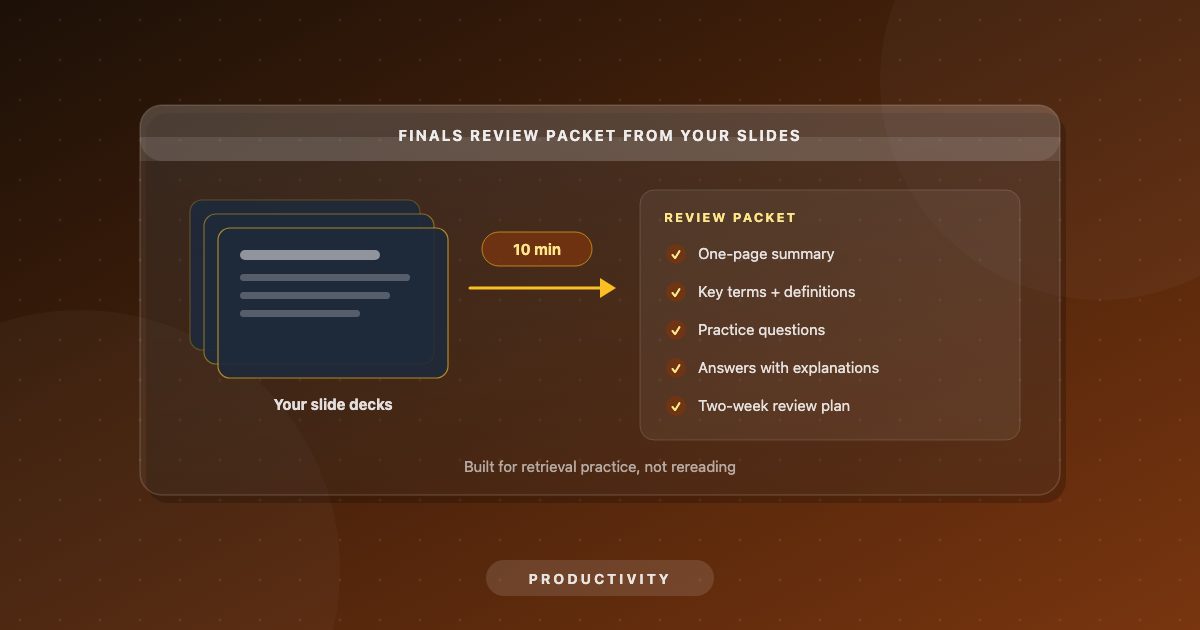
When you're behind, the slowest part is often turning a pile of lectures into something you can actually study from. Upload a module's slides, PDFs, readings or lecture recordings to Tutoremy and Remy, its study chat, builds a guide with organized notes, a short summary, flashcards and a practice quiz that explains every answer. The AI study guide maker page shows what that looks like, and the PowerPoint summarizer covers catching up from slides.
If a topic doesn't click, ask Remy to explain it in the simple or step-by-step style, or to quiz you until it sticks. Remy answers in your language too, which helps if you're studying in a second language. It can make mistakes, so check important details against your course materials. And it's a tool for catching up, not a substitute for talking to your tutor when you need to.
For exam season later in the year, how to study for college exams and the finals week study plan pick up where this guide leaves off.
You're not as far behind as it feels. Start with this week. Try Tutoremy free.
Frequently asked questions
Is it normal to fall behind in first year of university?
Yes. First year has less structure, more independent study and several modules with separate deadlines, often while you are adjusting to a new place. Many students fall behind at some point. What matters is noticing early, triaging the backlog and asking for help before deadlines arrive.
How do I catch up on weeks of missed lectures?
First keep up with this week’s lectures so the backlog stops growing. Then prioritize missed lectures that upcoming assessments depend on, and foundational topics later material builds on. Skim the slides first, watch at a speed you can follow, and write the key ideas in your own words.
Should I tell my tutor I am behind?
Yes, and earlier is better. Tutors and advisers can explain your options, such as extensions or extenuating circumstances processes, but these usually have deadlines. Go with something specific, like which modules you are behind in and what you have already tried.
Does first year count toward my degree?
It depends on your university and programme. In some, first-year marks count little or nothing toward the final classification as long as you pass; in others they count fully. Check your course handbook or ask your programme office rather than assuming.